


At first glance, the question sounds almost silly, yet it has a way of stopping people in their tracks. If the Sun is blazing hot and sitting right there in the sky, why does Earth feel warm while space itself remains freezing? The confusion recently resurfaced online when someone asked in a Facebook group called Physics is Fun, “if the sun is in the sky, why is there heat on earth but not in the sky?” It is the kind of question that feels obvious until you try to answer it, and then suddenly you realize how many assumptions you have been carrying around about heat, space, and how the universe actually works. That is why questions like this spread so quickly. They poke at the edges of our everyday understanding and reveal how strange reality really is.
Join a community of 14,000,000+ Seekers!
Subscribe to unlock exclusive insights, wisdom, and transformational tools to elevate your consciousness. Get early access to new content, special offers, and more!
What makes this question especially interesting is that it exposes a deeper misunderstanding about what heat actually is. Most of us intuitively imagine heat as something that exists on its own, like a substance that radiates outward from hot objects and fills the space around them. In reality, heat is not a thing you can scoop up or store in empty space. It is a process, a transfer of energy that only happens under certain conditions. Once you understand that, the mystery of cold space and a hot Sun begins to dissolve, and in its place appears something far more fascinating: an appreciation for how rare and delicate Earth’s balance truly is.

How Cold Space Really Is
Outer space is not just cool or uncomfortable. It is almost completely devoid of heat. The average background temperature of space is about 2.7 Kelvin, which translates to roughly minus 270 degrees Celsius or minus 455 degrees Fahrenheit. This faint warmth does not come from stars or galaxies actively heating space, but from the residual radiation left over from the early universe itself. Beyond that thin cosmic background, space offers very little in the way of thermal comfort.

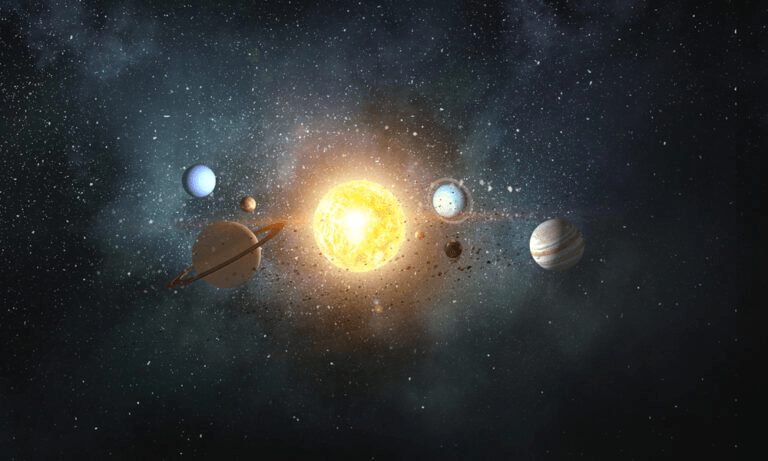
At the same time, the Sun represents one of the most extreme sources of heat in our solar system. Its core reaches temperatures of around 27 million degrees Fahrenheit, while its surface sits closer to 10,000 degrees. Even more counterintuitive, the Sun’s outer atmosphere, known as the corona, can reach temperatures of several million degrees, far hotter than the surface below it. These numbers only deepen the apparent paradox. How can such intense heat fail to warm the surrounding space?
The answer lies in understanding that temperature depends on matter. Without particles to absorb energy, even the most intense radiation cannot create warmth in the way we experience it. Space is cold not because it lacks energy entirely, but because it lacks enough material to turn that energy into heat.

The Sun Is Not Heating Space Like a Fire
Much of the confusion comes from how we instinctively picture the Sun. We imagine it like a giant fire, roasting nearby planets the way a campfire warms people standing around it. As one explanation puts it, “This seeming paradox probably comes from people thinking about the Sun intuitively as a hot fire, heating the planets like a toasty marshmallow near a bonfire.” That image feels right, but it does not reflect how heat actually moves through the universe.
The warmth we feel on Earth does not come from direct contact with the Sun’s heat. Instead, the Sun emits energy in the form of radiation across the electromagnetic spectrum, including visible light and infrared waves. These waves travel easily through empty space, but they do not heat space itself. They only produce heat when they strike matter and are absorbed.
Because space is almost a perfect vacuum, there are very few particles for this radiation to interact with. With nothing to absorb the energy, nothing heats up. The radiation simply passes through, leaving space cold and unchanged.
Why Earth Warms While Space Stays Frozen
Earth is warm because it is full of matter and movement. Our atmosphere is dense with molecules that readily absorb solar radiation. When sunlight hits these molecules, they gain energy and vibrate faster, which raises the temperature. That heat does not remain isolated in one spot. Molecules collide with one another, spreading warmth through conduction, while air currents and ocean circulation move heat around the planet through convection.
This is why Earth behaves so differently from airless worlds like Mercury. On Mercury, daytime temperatures can be more than a thousand degrees Fahrenheit hotter than nighttime temperatures because there is no atmosphere to store or distribute heat. Once the Sun sets, the warmth disappears almost instantly. Earth, by contrast, holds onto heat and releases it slowly, creating a relatively stable environment.
Radiation alone would not be enough to sustain this balance. It is the presence of an atmosphere, oceans, and active circulation that allows Earth to remain warm even when parts of the planet are not directly facing the Sun. This is what makes Earth habitable, and why its climate feels so mild compared to the extremes elsewhere in the solar system.
What Spacecraft Reveal About Heat and Cold
The strange rules of heat in space are not just theoretical. Engineers designing spacecraft must deal with them constantly. A striking example comes from missions that travel close to the Sun. Spacecraft can be exposed to intense solar radiation on one side while remaining extremely cold on the other, simply based on whether radiation is allowed to touch their surfaces.
As one engineer explained, “The job of that heat shield is to make sure ‘none of the solar radiation [will] touch anything on the spacecraft.’” With the radiation blocked, parts of a spacecraft can remain hundreds of degrees below freezing even while flying through the Sun’s outer atmosphere. This dramatic contrast highlights how unforgiving space can be. Heat appears instantly when radiation meets matter, and disappears just as quickly when that interaction is prevented.
These conditions may sound extreme, but they are normal for space. What is truly unusual is Earth, where multiple forms of heat transfer work together to smooth out temperature differences and create long-term stability.
A Deeper Meaning Behind the Physics
Beyond the science, there is something quietly profound in this explanation. The Sun constantly pours out energy, yet that energy only becomes warmth where there is something to receive it. Space remains cold not because the Sun is stingy, but because interaction is missing. Energy alone is not enough. Relationship is required.
This mirrors a deeper pattern that shows up again and again in human experience. Potential does not become meaningful until it is engaged with. Awareness does not turn into understanding until it meets form. In the same way that solar radiation needs matter to become heat, possibility needs structure to become reality.
Earth is not warm simply because it is close to the Sun. It is warm because it participates in a complex exchange, absorbing energy, transforming it, and redistributing it in a way that sustains balance. That balance is what allows life, consciousness, and reflection to emerge.

When Energy Meets Matter
So if the Sun heats the Earth, why is space cold? Because heat is not something that exists on its own. It is something that happens when energy meets matter. Space is cold because it is mostly empty. Earth is warm because it is full, active, and responsive.

The real takeaway from this viral question is not just a lesson in physics, but a reminder of how extraordinary our planet is. Between the frozen void of space and the searing heat of the Sun, Earth occupies a narrow and precious middle ground. Scientifically, that balance explains temperature. On a deeper level, it explains why this world can support life at all.
 30
30 0
0

 0
0
 0
0







